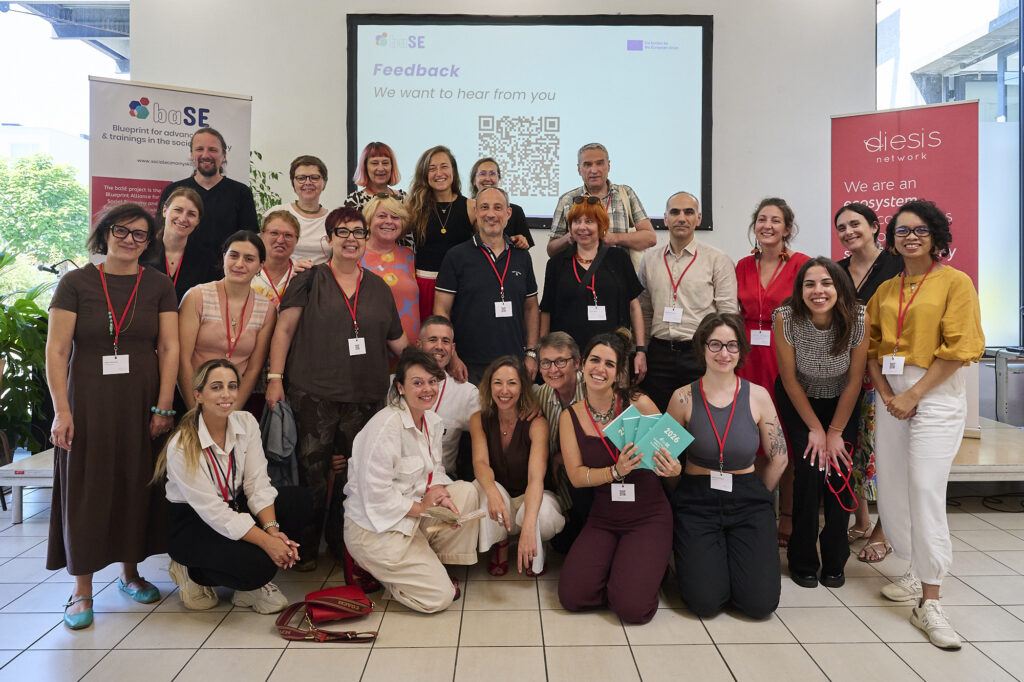
Couldn’t participate in the final event of baSE project?
We summarise here the main points about the Strengthening Skills for the Social Economy event:
Official Opening: Introduction to the baSE Skills Journey
- Economic Necessity: Marta Bruschi (Diesis Network) emphasized that by 2030, nearly 40% of worker skills will change due to automation and the digital and green transitions. Consequently, investing in people is no longer just a social objective but an “economic necessity” to address the European skills gap.
- Project Milestones: Over four years, the baSE project developed SocioComp, a first-of-its-kind European competence framework for the social economy. The project also updated occupational profiles and training curricula across more than 10 countries to respond to evolving industrial needs.
- The Triple Transition: Ane Sanchez-Zeziaga (Mondragon University) highlighted that the project serves as a bridge between EU macro-strategies and the daily operations of social enterprises. She framed the social economy’s mission around a “triple transition”:
- Digital: Used as a tool rather than an end in itself.
- Green: Aimed at an economy that respects planetary boundaries.
- Inclusive: Ensuring the transition drives quality employment rather than exclusion.
- Cross-Sectoral Model: Anna concluded that the social economy is not merely a “what” but a “how”—a model that guarantees internal democracy and social justice across all ecosystems.
Session I: Competitive Social Economy and Skills That Matter
- EU Agenda: Baptiste Mandouze (DG EMPL) stated that skills are a top priority for the EU, noting that investing in workers throughout their professional lives is essential for the “prosperity agenda”. He identified “curiosity and the desire to learn” as the most vital skills for adapting to an uncertain future.
- Human-Centered Competitiveness: Marina Monaco (ETUC) argued that competitiveness is impossible without investment in people. She stressed that skills acquisition must be “based on rights” and accessible to everyone, regardless of age, noting that elderly workers often face the highest levels of training discrimination.
- Transversal Competencies: Veronica Arduino (LLLP) shifted the focus from technical skills to competencies, such as critical thinking and “learning to learn”. She argued that education should be a path for personal fulfillment and social cohesion, and that the social economy naturally develops these through participatory governance.
Session II: Blueprint for Social Economy – baSE Roadmap
- Schools of Democracy: Iñigo Albizuri (Mondragon Corporation) described social economy companies as “schools of democracy”. He emphasized that future skills must include cooperation, democratic governance, and ethical leadership to ensure that technology serves human goals.
- From Blueprint to Action: Iñigo stressed the importance of turning the project’s ideas into real-world results, stating that the project’s “legacy” depends on implementing these training programs to build better communities and more social businesses.
- Practical Piloting in France: Jossie Ravomanana (ESS France) detailed the practical implementation of baSE training for over 150 participants in France. The training focused on:
- Helping organizations rethink economic models to be sustainable in the long term.
- Using tools like vulnerability analysis and double materiality to integrate ecological transitions into global strategies.
- Developing resilient organizations through peer learning and regional collaboration.
Skills strategies session: Reflection and sustainability
- What are the biggest barriers in scaling gap to translate/transfer the work done in baSE into a national/regional level?
In terms of barriers one participant from Latvia (baSE partner) says that we usually have an overwhelming amount of workshops, sessions, etc. We need to start looking for synergies/clusters. Project results are good because of the label/brand of Social Economy and now it’s time to start working on synergies as the aftermath of the baSE project’s work. It’s heritage cannot go unnoticed.
A Diesis network representative added that “It’s important not to start from scratch but to use what we already have”. Another thing is that there are many toolkits so again we need to ask ourselves how to embellish their significance so that we have lots of people, actors, stakeholders, municipalities who can see power and effectiveness in the toolkit developed by the baSE.
Another participant of this session (from Serbia) says that formal education is a chance for the materials. Tools in formal education make sense but the system is not favorable yet in his country so provided most European countries have more systemic openness to Social Economy then these materials would make great impact in education. It’s worth approaching decision-makers/educators, etc. Another representant from Serbia says that in countries like Serbia there is no strong SE network. So they look for alternatives to have an outreach of SE. Most of the time they have to go bottom up in raising awareness and so forth.
- Which of baSE tools is most necessary in your country ?
SocioComp, MOOC platform, training, catalogue, and f2f training as most frequently indicated.
- Which of baSE tools would you use instantly? Easily adaptable, right back when you get home to your organization?
MOOC platform, and SE Insider magazine as most frequently indicated.
- Which of baSE tools which you like to see implemented as a systemic solution?
Sociocomp, f2f training, and MOOC platform, as most frequently indicated.
Round-closing session
– Filling Educational Gaps: In most countries, social economy training is not part of “everyday life in high school” or mainstream university curricula. Organizations often have to teach themselves democratic governance and sustainable economic models through work experience.
– Focus on Soft Skills and Resilience: Sarah de Heusch (SEE) noted that while EU skills policy often focuses on STEM, the social economy contributes essential “soft skills” that are vital for societal resilience. These include “identifying an issue, finding a solution, making the solution sustainable, and wrap it all up with a democratic governance”.
– The Pact for Skills: Felix Rohn (DG EMPL Blueprint) identified the Large-Scale Skills Partnership (LSP) for the social economy as the primary platform for “spreading and exploiting the project results”. He noted that the Pact for Skills is “here to stay” and that the Commission intends to reinforce it to facilitate cooperation between different industrial ecosystems.
– Purpose-Driven Competitiveness: Rohn pointed out that the social economy has a unique competitive advantage in the labor market: “You address young people of today” who prioritize “purpose” over salary.
– Informal vs. Formal Education: In countries with centralized or rigid education systems, participants suggested using the project results as “an informal tool for the formal education”. For example, professors can integrate tools directly into regular classes without waiting for official accreditation; they must use “alternative ways” like informal mentoring, games, and hackathons to reach people one-on-one.
– Continuing Vocational Training (CVT): Rohn suggested that implementation is often easier through continuing education rather than initial vocational training, as industry actors have more freedom to recognize micro-credentials, certificates, or badges.
– Centers of Vocational Excellence (CoVEs): Rohn recommended that the next step after the “blueprint” is to apply for CoVE projects, which work at a regional level. This allows the European strategy to be “broken down” and “made more granular” to fit regional smart specialization strategies.
We conclude with Sarah de Heusch statement: “This is maybe the end of the baSE project, but it’s just the beginning of the implementation”
You can also accompany the recording of the event in our YouTube channel: https://youtu.be/7LoV1JH4PFQ
And check the photos by Jerome Hubert here: https://photo.jeromehubert.be/the-future-of-the-social-economy/day3/
Keep following our media for more inputs as we still have deliverables to publish:
https://www.linkedin.com/showcase/base-project/about/?viewAsMember=true